Knowledge base
Jaguar's History and Where the Mk2 Fits
By Jon Cosson — classic-car owner, North Yorkshire, near Thornton-le-Dale
On the E-Type Archive
Jaguar: The Complete History, 1922 to today, and Jaguar Cars Compared, 1948 to 1975. The figures on this page come from the comparison. Both open in a new tab.
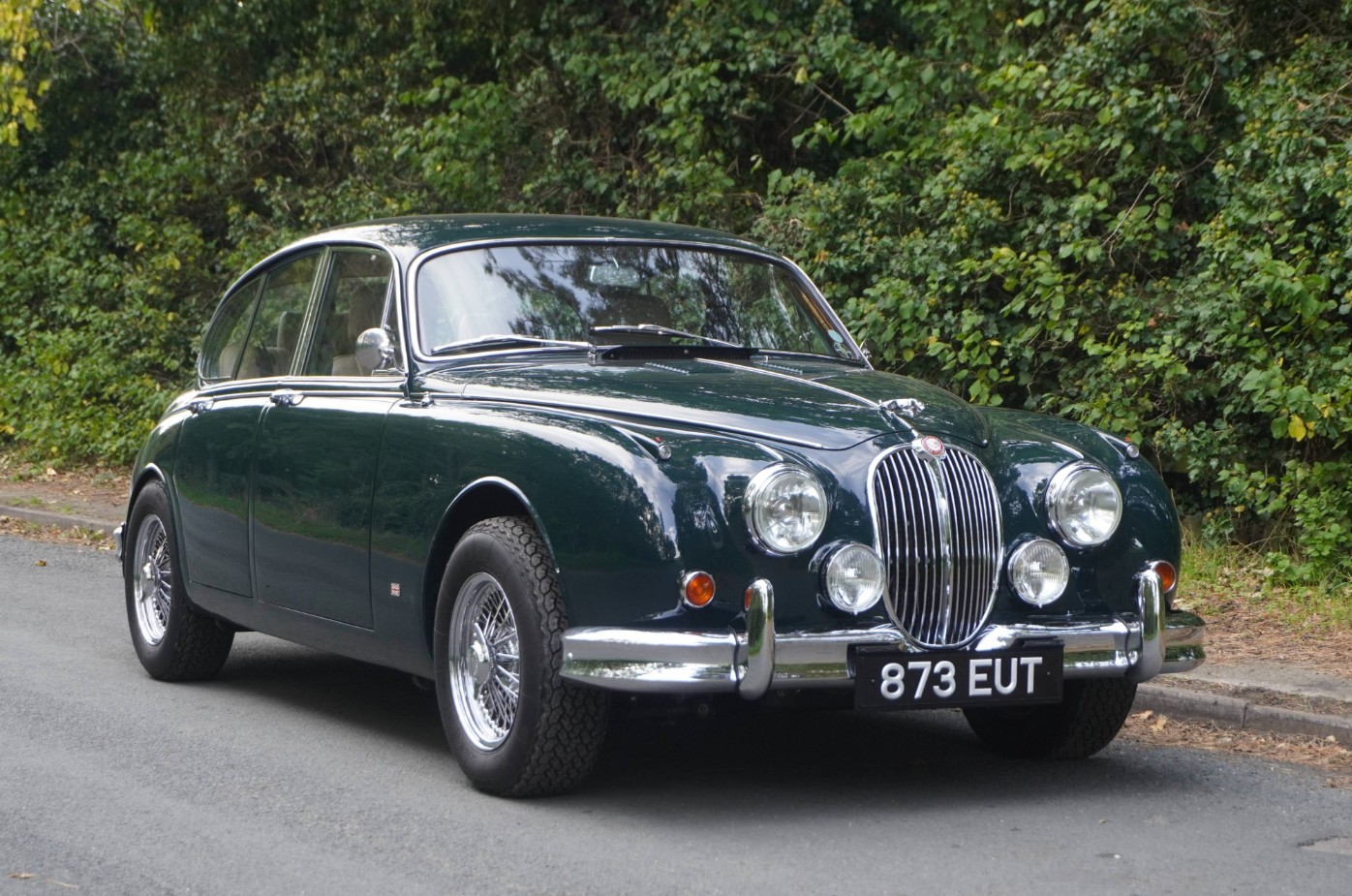
The Mk2 was launched in October 1959, thirty-seven years after William Lyons started making sidecars in Blackpool and nine years before the XJ6 made the whole compact saloon range redundant. To understand why the Mk2 is the car it is, with its twin-cam engine, its monocoque body and its disc brakes on every wheel, it helps to know what Jaguar had been doing in the decade before it. This is the short version. The full company history, from 1922 to the present day, is on our companion E-Type site and is linked at the foot of the page.
From sidecars to SS saloons, 1922 to 1945
William Lyons and his neighbour William Walmsley founded the Swallow Sidecar Company in Blackpool in September 1922, the month Lyons turned 21. Five years later they were building stylish bodies on Austin Seven chassis, and in October 1928 they moved to Coventry. The SS1 of 1931, their first car of their own, on a low chassis built for them by the Standard Motor Company, cost £310 and was said to have the £1,000 look.
The saloon tradition the Mk2 belongs to begins on 21 September 1935, when Lyons unveiled the SS Jaguar 2½-litre saloon at the Mayfair Hotel in London. Guests were asked to guess its price and averaged £632. It cost £395. That combination of looks, performance and a price that seemed like a mistake was the Jaguar formula for the next forty years, and the Mk2 is perhaps its purest expression. In 1938 the saloons moved to all-steel bodies, and on 23 March 1945 the company dropped the SS initials and became Jaguar Cars Ltd.
The engine the Mk2 inherited
The Mk2's XK engine was planned on the factory roof during the war, when Lyons and his engineers William Heynes, Walter Hassan and Claude Baily spent Sunday nights fire-watching and talking about the engine they would build when peace came. The result, a 3,442 cc twin-overhead-camshaft straight six, was shown in the XK120 at Earls Court in October 1948. The following May an XK120 reached 132.6 mph on the Jabbeke highway in Belgium, which Motor Sport called the highest speed yet reached by a production car.
The engine went into the big Mark VII saloon in 1950, and into the C-Type and D-Type racing cars that won Le Mans in 1951, 1953, 1955, 1956 and 1957. One strand of that racing matters directly to the Mk2. Jaguar developed disc brakes with Dunlop on the C-Type; Stirling Moss won at Reims on 29 June 1952 in the first race ever won by a disc-braked car, and Jaguar won Le Mans on discs in 1953. Six years after that the Mk2 became the first compact Jaguar with discs on all four wheels as standard.
The compact saloon, 1955 to 1959
In September 1955 Jaguar announced the 2.4 Litre, the car now called the Mk1. It was the first Jaguar built without a separate chassis, with a unitary steel body made by Pressed Steel, and it carried a short-stroke 2,483 cc version of the XK engine. The 3.4 Litre followed in 1957, aimed at America, and disc brakes became an option late that year. In the first British Saloon Car Championship in 1958, Tommy Sopwith's 3.4 tied on points for the title before losing a run-off.
The compact saloon also brought Jaguar one of its saddest losses of the period. Mike Hawthorn, world champion in 1958, was killed on 22 January 1959 when his own 3.4 crashed on the Guildford bypass in heavy rain.
The Mk2, 1959 to 1967
The Mk2 was launched on 2 October 1959. Larger windows, a wider rear track and four-wheel disc brakes as standard made it more modern, safer and better-looking than the car it replaced. With the 3.8-litre engine it could reach 125 mph, and it was taken up by businessmen, racing drivers and the police forces who patrolled the new motorways in it. Around 84,000 were built, making it the best-selling Jaguar of the Lyons era until the XJ6.
Jaguar bought Daimler in 1960, mainly for its Radford factory, and in 1962 put Daimler's 2.5-litre V8 into the Mk2 body as the Daimler 2.5 V8. The S-Type of 1963 added independent rear suspension and a longer tail to the Mk2 shell, and the 420 of 1966 gave the S-Type a new nose and the 4.2-litre engine. By then Jaguar was selling five different saloon families at once. In 1967 the Mk2 itself became the cheaper 240 and 340, which have their own page on this site.
The XJ6 and the end of the line
Lyons' answer to the crowded range was one car. The XJ6, launched on 26 September 1968, replaced the 340, the S-Type and the 420 together, and the 240 and 340 ran on until 1969. By then Jaguar had merged with BMC in 1966 and been absorbed into British Leyland in January 1968. Lyons retired as chairman in 1972, after fifty years in charge. The Mk2 belongs to the last decade in which Jaguar was his company alone, and it shows.
The Mk2 and its relatives
| Model | Built | Engine | Power (gross) | Brakes | Period road test | UK price at launch, with tax | Number built |
|---|---|---|---|---|---|---|---|
| 2.4 and 3.4 (Mk1) | 1955 to 1959 | 2,483 or 3,442 cc six | 112 or 210 bhp | Drums; discs optional from late 1957 | The Motor, 1957 (3.4 automatic): 119.8 mph, 0 to 60 mph 11.2 s | £1,532, 2.4 with overdrive, 1956 | 37,397 |
| Mk2 | 1959 to 1967 | 2,483, 3,442 or 3,781 cc six | 120, 210 or 220 bhp | Discs | Motor Sport, 1960 (3.8): 125 mph | £1,779, 3.8, 1960 | About 84,000 |
| Daimler 2.5 V8 and V8-250 | 1962 to 1969 | 2,548 cc V8 | 140 bhp | Discs | Autocar, 1966: 112 mph, 0 to 60 mph 13.6 s | £1,569, 1962 | About 17,900 |
| S-Type | 1963 to 1968 | 3,442 or 3,781 cc six | 210 or 220 bhp | Discs, inboard at rear | Motor Sport, 1966 (3.8 overdrive): over 121 mph | £1,886, 3.8 automatic, 1964 | 24,993 |
| 420 | 1966 to 1969 | 4,235 cc six | 245 bhp | Discs | Not verified | £1,930, 1966 | 10,236 |
| 240 and 340 | 1967 to 1969 | 2,483 or 3,442 cc six | 133 or 210 bhp | Discs | Not verified | 240 £1,365; 340 £1,422, 1967; tax status not confirmed | 240: 4,446; 340: 2,800 |
| XJ6 Series 1 | 1968 to 1973 | 2,792 or 4,235 cc six | 180 or 245 bhp | Discs, inboard at rear | Not verified | £2,258, 4.2, 1968 | About 98,500, all Series 1 XJs |
Figures are from the comparison table on our E-Type site, where the sources and the places where they disagree are set out in full. Production totals come from the Jaguar Daimler Heritage Trust and the Jaguar Enthusiasts' Club; the Mk2 total is given as 83,701 by the Trust and 84,180 by the club. "Not verified" means no period road test has yet been confirmed for that model.
Read the full story
The Jaguar E-Type Archive, our companion site, carries the complete history of the company from the Swallow sidecar to the electric Type 01, and a comparison of more than twenty-five Jaguar sports cars, saloons and racing cars built between 1948 and 1975, with a chart showing which models were on sale at the same time. Both links open in a new tab.
Common questions
- When was the Jaguar Mk2 launched?
- On 2 October 1959, replacing the 2.4 and 3.4 Litre saloons now known as the Mk1. It was built until 1967, when it became the 240 and 340.
- How many Jaguar Mk2s were built?
- About 84,000. The Jaguar Daimler Heritage Trust gives 83,701 and the Jaguar Enthusiasts' Club 84,180, so the exact figure depends on which register you use.
- Why does the Mk2 have disc brakes on all four wheels?
- Jaguar developed disc brakes with Dunlop for the C-Type racing car in 1952 and won Le Mans with them in 1953. The Mk2 of 1959 was the first compact Jaguar to have them as standard on every wheel.
- What replaced the Mk2?
- Directly, the 240 and 340 of 1967. In practice the XJ6 of September 1968, which replaced the 340, the S-Type and the 420 with a single car.